

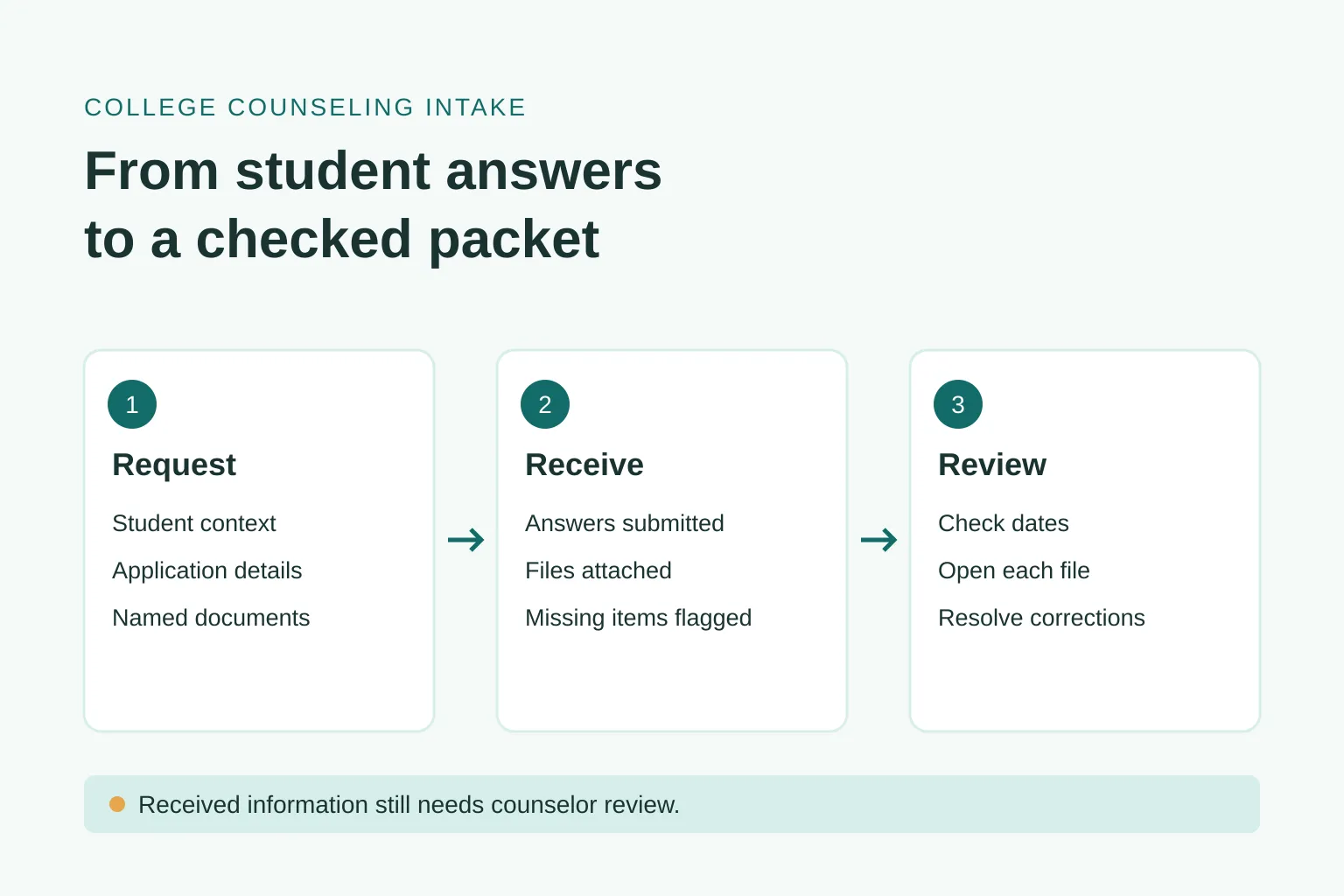
A college counseling intake form should collect student context, academic information, activities, recommendation plans, application deadlines, and clearly named documents. Mark what is required before the next meeting and let students flag details they don't know yet. Use the template below as a starting point, then review the answers and files before treating the packet as complete.
What belongs in a college counseling intake form?
A college counseling intake form has two jobs: help the counselor understand the student and gather the information needed for the next advising task. An introductory consultation may only need background and goals. A student preparing applications needs more detailed records, dates, and files.
Choose the sections for the student's stage before sending the form. A younger student who hasn't chosen colleges shouldn't have to invent application deadlines to submit an introductory questionnaire.
Copy this student intake template
Add your practice's contact details, submission instructions, and requested date. Mark individual fields as required or optional rather than making every question mandatory.
Opening instructions
“Please complete the requested sections before our meeting on [meeting date]. Send your intake by [requested date] through [submission method]. Short answers and working drafts are welcome. If you're unsure about a detail, write ‘needs discussion.’ If a required document isn't available, contact [counselor contact] so we can agree on the next step.”
1. Student and family contact details
- Student's name, preferred name, pronouns if they wish to share them, and email.
- High school, current grade, and expected graduation year.
- Parent or guardian contact details, where appropriate to the engagement.
- Preferred way to receive reminders and any communication needs.
Ask only for contact information you'll use. Keep account passwords and identity-document numbers out of the intake form.
2. Goals and questions, in the student's own words
- What would you most like help with during our next meeting?
- Which subjects, interests, or careers would you like to explore?
- What matters to you in a college: location, setting, size, programs, cost, or something else?
- Which colleges are you considering, if any?
- Is there anything you'd prefer to discuss privately rather than write here?
Invite parents or guardians to add their perspective separately, with the speaker identified. That preserves the student's own answers. For a welcoming approach to family context, Joyful Journey's intake form asks about hopes, concerns, and family roles while allowing brief or optional responses.
3. Academic information
- Current courses and planned courses, if known.
- Most recent grades or transcript, with the date the record was issued.
- Test results and planned test dates, if relevant to the student's application plans.
- Academic questions or circumstances the student wants to discuss; make personal context optional.
If you request a GPA, ask the student to include the scale and whether the school labels it weighted or unweighted. A number without that context can be misread.
4. Activities and responsibilities
For each activity, collect:
- Activity or organization name and the student's role.
- Grades or dates of participation.
- Approximate hours per week and weeks per year, where known.
- Responsibilities, contributions, and any awards.
Prompt students to include paid work, family care, independent projects, and community involvement alongside school clubs. Let them mark time estimates as estimates instead of guessing precise figures.
5. Recommendation preparation
- Potential recommender's name and subject or role.
- How the recommender knows the student.
- Whether the student has asked, and whether the recommender has agreed.
- Relevant request deadline and any school-specific instructions already received.
- Experiences or work the student might discuss with that recommender.
Keep “potential recommender,” “asked,” and “agreed” distinct. A name on a form doesn't establish that someone has accepted the request.
6. Application plans and dates
For each college currently under consideration, ask for the institution, program if relevant, intended application round, deadline, and source of that date. Include a place to note whether the plan is undecided.
Record your own intake due date separately from the institution's application deadline. Before using a student-entered date to plan work, check the institution's current admissions page.
7. Named document requests
Replace “upload your documents” with a list the student can check:
| Document | Instruction to include |
|---|---|
| Current transcript | Specify which completed term or school year the copy should show. |
| Activity résumé, if used | Say whether a working draft is acceptable. |
| Other document needed for this meeting | Name it and explain why you need it. |
State the accepted file formats, size limits, and submission location for whichever system you use. If a document is required, give students a way to report that it isn't available rather than uploading an unrelated file to move forward.
Review the packet before marking it complete
Use separate statuses for missing, received, needs correction, and reviewed. Open every requested file, check that it belongs to the student and contains the requested information, and resolve unclear answers. Mark the packet complete only when its required items have been received and checked.
Say a student's intake is due October 8 and the advising meeting is October 12. On October 8, their answers and résumé arrive, but the transcript ends before the most recent completed term. Record the transcript as “needs correction,” not “reviewed,” and send:
“Thanks for sending your intake. The transcript attached stops before your most recent completed term. Please send an updated copy through [submission link] by October 10 so I can review it before our October 12 meeting. If you can't get it by then, reply and we'll agree on a next step.”
Those dates are counselor-requested preparation dates. They don't change an institution's application deadline.
Prepare a checklist before collecting answers
Kivora's free intake preparation checklist lets counselors select activities, recommendation details, deadlines, and document requests, then print or share a blank checklist. The checklist helps students gather materials; its shared link is not a private student submission link.